
In the hyper-connected landscape of 2026, our brains are under constant siege. From the moment we wake up and check our augmented reality feeds to the late-night infinite scroll on social platforms, we are trapped in a “Dopamine Loop.” This cycle of instant gratification has fundamentally altered our neural recalibration processes, leaving the average college student with an attention span shorter than a viral transition clip. When your cognitive load is permanently red-lining, your ability to engage in “Deep Work” vanishes, replaced by a persistent brain fog that makes even the simplest lecture feel like a marathon. To fix this, we need more than a nap; we need a systematic 72-hour focus challenge to reset our internal chemistry.
The first step to recovery is acknowledging that academic burnout and digital distraction are physiological, not just psychological. Your prefrontal cortex—the part of the brain responsible for decision-making and focus—gets exhausted when it has to filter through thousands of notifications daily. If you feel overwhelmed by your workload, remember that seeking Assignment Help from a trusted brand like myassignmenthelp can provide the breathing room necessary to start your detox without falling behind. By offloading the densest research tasks to experts, you can focus on lowering your baseline dopamine levels and restoring your brain’s natural ability to concentrate on complex information.
The Science of the “Dopamine Baseline”
To understand why a 72-hour reset is necessary, we must look at how the brain processes rewards. Dopamine is not the “pleasure chemical”; it is the “anticipation chemical.” It drives us to seek out new information. In 2026, the internet is designed to provide infinite novelty. Every time you pull down to refresh a feed, your brain receives a spike of dopamine. Over time, your brain develops a tolerance.
When your tolerance is high, everyday tasks like reading a textbook or writing a thesis feel incredibly painful because they don’t provide the same “hit” as a smartphone. This lead to chronic study procrastination. A 72-hour “Information Fast” forces your brain to down-regulate its receptors, making low-stimulation activities feel rewarding again.
The 72-Hour Roadmap: A Step-by-Step Recovery
| Phase | Duration | Primary Objective | Key Restrictions |
| Phase 1: The Blackout | Hours 1-24 | Break the Habitual Loop | No Screens, No Music, No Junk Food |
| Phase 2: The Void | Hours 25-48 | Lower Dopamine Baseline | No Artificial Stimuli, Only Analog Tasks |
| Phase 3: The Re-Entry | Hours 49-72 | Strategic Neural Loading | Controlled Tech Use, High-Value Reading |
Phase 1: The 24-Hour Digital Blackout (Day 1)
The first 24 hours are the hardest because of “Withdrawal Anxiety.” This is the period where your brain screams for the quick dopamine hits it usually gets from likes, comments, and short-form videos. To successfully initiate a brain reset, you must implement a total “Information Fast.” This means no social media, no streaming, and no news cycles.
During this blackout, your brain begins to realize that the constant “noise” is gone. This allows your nervous system to shift from a state of “High Arousal” to “Rest and Digest.” Put your phone in a timed lockbox or give it to a friend. If you must use a computer for essential tasks, use a grayscale filter to make the screen less “rewarding” to your visual cortex.
Phase 2: Embracing the “Productive Void” (Day 2)
By the second day, the initial itch to check your phone will subside, replaced by a strange sense of boredom. In 2026, we have forgotten how to be bored, yet boredom is the birthplace of neuroplasticity. When the brain isn’t being fed external stimuli, it begins to look inward, sparking creative thought and problem-solving.
This is the optimal time to engage in monotasking. Instead of trying to juggle five different projects, pick one manual task—like cooking a complex meal or journaling with a physical pen—and give it your undivided attention. If you find yourself worrying about technical debt or complex coding projects, remember that opting for computer science homework help can ensure your technical requirements are met while you remain offline. This strategy ensures your GPA remains protected while your mind undergoes a much-needed dopamine detox.
Phase 3: Re-Entry and Neural Optimization (Day 3)
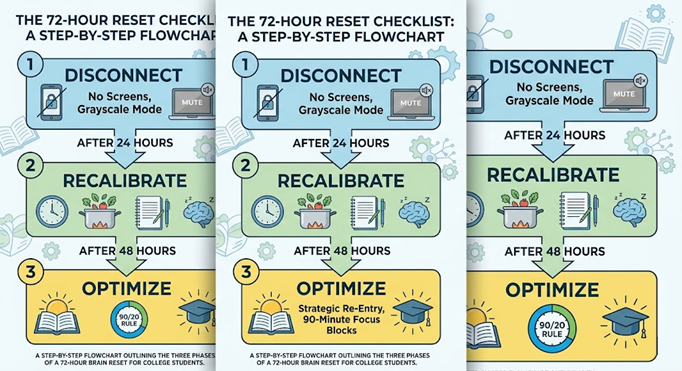
The final 24 hours are about “Re-entry Strategy.” You cannot simply go back to your old habits, or the 72-hour brain reset will be wasted. On Day 3, you introduce “High-Value Stimuli” back into your life. Read a physical book, go for a long walk without headphones, or engage in a face-to-face conversation.
You are training your brain to appreciate “Slow Information.” This is the foundation of Topical Authority—the ability to stay with a subject long enough to master it rather than just skimming the surface.
Visualizing the Reset: The Focus Recovery Curve
To better understand how your brain recovers during this 72-hour window, consider the following progression of cognitive states:
- Hour 0-12: High Irritability / Phantom Vibration Syndrome (reaching for a phone that isn’t there).
- Hour 12-24: Mental Fatigue / Feeling of “Empty Time.”
- Hour 24-48: Rise in Creative Visualization (Your brain begins to daydream again).
- Hour 48-72: Increased Sensory Awareness / Ability to read for 60+ minutes without distraction.
[Flowchart: The Neural Recalibration Path]
Input: Digital Overload -> Phase 1: Cortisol Spike & Withdrawal -> Phase 2: Baseline Reset & Synaptic Pruning -> Phase 3: Intentional Re-Entry -> Output: Peak Focus State.
Overcoming the “Fear of Missing Out” (FOMO)
The biggest barrier to a 72-hour reset is the fear that you will miss an important update, a social event, or an academic deadline. However, in the age of Agentic AI, the world moves faster than any human can track. Trying to keep up is a losing battle.
Instead of FOMO, aim for JOMO—the Joy of Missing Out. By stepping away, you gain a competitive advantage. While your peers are distracted by the latest viral controversy, you are building the mental stamina required for systematic literature reviews and complex thesis proofreading.
Tactical Tips for Maintaining Focus Post-Reset
Once you have completed your 72-hour journey, you must guard your new prefrontal cortex health with “Digital Guardrails.”
- The 90-Minute Rule: Work in 90-minute intervals of total silence, followed by a 20-minute analog break.
- Analog Sundays: Make every Sunday a screen-free day to prevent dopamine levels from creeping back up.
- Physical Environment: Create a “Deep Work Zone” where no phones are allowed. Your brain will begin to associate that physical space with high-level concentration.
- Information Quality: Treat information like food. Avoid “junk” content (clickbait) and seek out “nutritious” content (long-form essays and peer-reviewed journals).
The Role of Professional Support in Student Wellness
We often feel the need to be “always on” because the academic workload in 2026 is immense. Between lab reports, essays, and coding assignments, the pressure is relentless. This is where the “10% Outsourcing Rule” comes into play.
Smart students realize that they cannot do everything perfectly. By delegating technical formatting, bibliography management, or academic research support to professional services, you reduce your cognitive load. This isn’t about “getting out of work”; it is about optimizing your mental energy so you can focus on the core concepts that actually matter for your degree and future career.
Final Thoughts: The Human Advantage
In a world increasingly dominated by AI-generated content, the most valuable skill a human can possess is the ability to focus. A 72-hour brain reset is not a one-time event; it is a vital maintenance script for your biological hardware. By reclaiming your attention, you aren’t just improving your grades—you are reclaiming your life from the algorithms.
The transition from a “Digital Ghost” to a focused, high-performing student starts with the courage to turn it all off. Start your 72 hours tonight, and by this time three days from now, you will be seeing the world with a clarity you haven’t experienced in years.
Frequently Asked Questions
How do I know if I need a cognitive reset? If you experience persistent mental fatigue, find it impossible to read more than a few pages without checking your phone, or feel anxious when away from a screen, your dopamine receptors are likely overstimulated and in need of a baseline adjustment.
Is it okay to use a laptop for work during the 72 hours? For the most effective results, a total digital fast is recommended. However, if urgent tasks are unavoidable, switch your display to grayscale and disable all notifications to minimize the “reward” triggers associated with your device.
What are the best analog activities to fill the time? Focus on tactile hobbies that require slow, deliberate movement. Engaging in physical journaling, preparing meals from scratch, light exercise, or reading printed books helps your brain transition from high-speed digital consumption to deep, sustained focus.
Will my focus stay improved after the three days are over? The reset provides a clean slate, but long-term success depends on your habits. To maintain your new mental clarity, you must implement strict boundaries, such as scheduled offline hours and dedicated spaces for uninterrupted concentration.
About The Author
Mark is a dedicated Lead Content Strategist at MyAssignmentHelp, where he focuses on the intersection of digital wellness and academic success. With a passion for helping students optimize their mental performance, he develops actionable frameworks that balance modern technology with traditional research discipline.
